Why Computer Recycling Matters in Los Angeles
Los Angeles is one of the largest technology markets in the world, which means it also generates enormous volumes of electronic waste. Every year, LA County residents and businesses discard hundreds of thousands of computers, laptops, and servers. Without proper recycling, these devices release toxic chemicals like cadmium, beryllium, and lead into landfills and groundwater.
Computer recycling Los Angeles is not just an environmental imperative — it is also a data security necessity. Old hard drives, SSDs, and even motherboards can retain sensitive information long after the computer stops working. A 2023 study found that 40% of used hard drives sold online still contained recoverable personal data. Responsible recycling ensures both environmental protection and information security.
- One desktop computer contains enough toxic materials to pollute 2 tons of water
- Recoverable metals in a single laptop include gold, copper, palladium, and aluminum
- California generates more e-waste than any other US state — over 200,000 tons annually
- Improper computer disposal is a Class C misdemeanor in Los Angeles County
What Types of Computers Can Be Recycled?
At Greenly Electronics Recycling, we accept virtually every type of computing device. From vintage 1990s desktops to cutting-edge gaming rigs, every unit contains valuable materials worth recovering. Here is what we typically process:
- Desktop Computers: Tower cases, all-in-ones, mini PCs, and workstations. We separate the power supply, motherboard, drives, memory, and chassis for individual material streams.
- Laptops & Notebooks: Every brand — Apple MacBook, Dell, HP, Lenovo, ASUS, Acer, and more. We remove batteries first (lithium-ion requires special handling), then disassemble the chassis, screen, keyboard, and internal components.
- Servers & Rack Equipment: Enterprise servers, network-attached storage, blade servers, and UPS units. Server recycling requires extra care due to redundant drive arrays and sensitive business data.
- Tablets & Hybrids: iPads, Microsoft Surface devices, Chromebooks, and 2-in-1 convertibles. These compact devices often contain rare earth elements in their display and battery systems.
- Peripherals & Accessories: Monitors, keyboards, mice, printers, scanners, webcams, and cables. Even small accessories contain recoverable plastics and metals.
Data Security: What Happens to Your Hard Drive
Data destruction is the most critical step in computer recycling. At Greenly, every data-bearing device undergoes a rigorous multi-step security process before any material recovery begins.
For standard residential recycling, we perform a DoD 5220.22-M compliant multi-pass data overwrite on all functional hard drives and SSDs. This process writes random data patterns across the entire drive surface multiple times, making recovery impossible with any commercially available forensic tool.
For businesses, healthcare providers, financial institutions, and government agencies, we offer certified physical hard drive shredding. Drives are fed into an industrial cross-cut shredder that reduces them to confetti-sized particles. You receive a detailed Certificate of Destruction with serial numbers, destruction date, and chain-of-custody documentation that satisfies HIPAA, SOX, GLBA, and PCI-DSS audit requirements.
- Free DoD-standard data wiping on all computers we recycle
- Physical hard drive shredding available with Certificate of Destruction
- HIPAA-compliant destruction process for healthcare organizations
- Chain-of-custody documentation for enterprise security audits
- Witnessed destruction available for highly sensitive environments
How to Prepare Your Computer for Recycling
Preparing a computer for recycling is straightforward. You do not need to erase your hard drive before bringing it to us — our certified data destruction process handles that securely. However, there are a few steps that make the process smoother:
- Back up any files you want to keep to an external drive or cloud storage
- Remove any personal accessories you want to reuse (mouse, keyboard, monitor if still working)
- For laptops, leave the battery installed — we handle lithium-ion battery removal safely
- If recycling multiple computers, group them together for faster check-in
- For business pickups, provide an inventory list for our tracking system
Where to Recycle Computers in Los Angeles
Greenly Electronics Recycling operates two free drop-off locations in Los Angeles, both open Monday through Friday from 8am to 5pm, plus Saturday hours at select times. No appointment is needed for residential drop-off — just bring your computers to the front desk and our team will handle everything.
For businesses with large quantities (10+ computers, servers, or monitors), we offer free pickup anywhere in Los Angeles County. Our fleet covers Burbank, Glendale, Pasadena, Long Beach, Santa Monica, Culver City, the San Fernando Valley, Downtown LA, and every neighborhood in between. We bring packing materials, labels, and dollies so your team does not have to prep anything.
Frequently Asked Questions
Is computer recycling free in Los Angeles?
Yes. Residential computer recycling is completely free at both Greenly Electronics Recycling locations in Los Angeles. We accept desktops, laptops, servers, monitors, and all computer accessories at no charge. Free business pickup is available throughout LA County for qualifying quantities of 10 or more devices.
Do I need to erase my hard drive before recycling my computer?
No — you do not need to wipe your hard drive before bringing it to us. Our certified data destruction process handles all data-bearing devices securely. We perform DoD-standard multi-pass overwrites on functional drives and physical shredding for businesses requiring maximum security. Your data is protected from the moment the device enters our facility.
Can I recycle a computer that does not turn on?
Absolutely. Non-working computers are recycled the same way as functional ones. The only difference is that non-functional drives go directly to physical destruction rather than software wiping. We still recover all metals, plastics, and circuit board materials from dead computers through our standard disassembly process.
What happens to my computer after I drop it off?
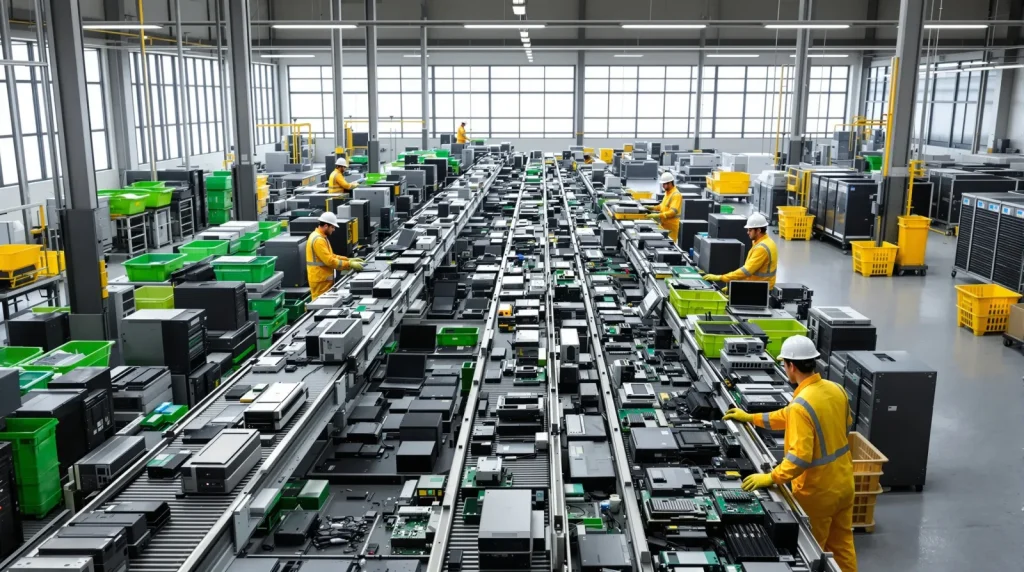
Your computer is logged into our tracking system, then moved to our secure disassembly area. Data-bearing components are separated first and processed through our certified destruction protocol. Remaining materials — metals, plastics, glass, and circuit boards — are sorted into dedicated recovery streams and sent to certified downstream processors. Nothing goes to landfill.
Do you recycle Apple MacBooks and iMacs?
Yes. We recycle all Apple products including MacBooks, iMacs, Mac Minis, Mac Pros, and Apple displays. Apple devices often contain specialized components like proprietary batteries and soldered storage that require careful handling. Our technicians are trained on Apple-specific disassembly procedures to maximize material recovery.